
178 – PKN Magazine
Access to digital version (NL & En) (only members)
An advertising pipe for the Van der Pas tobacco factory in ’s-Hertogenbosch - Bert van der Lingen

- The Steam Tobacco and Cigar Factory J.J. van der Pas at Markt no. 2 in ’s-Hertogenbosch had a promotional pipe made by the Gouda firm P.J. van der Want Azn in the period 1885–1920. On the left side of the bowl is the text VAN DER PAS ’S BOSCH and on the right TABAKSFABRIEK MARKT No. 2. On the left side of the heel is the coat of arms…
Of three-masters and warships: a newly discovered Heel Mark?

- During the identification of a find of approximately 150 marked pipe bowls from the Nieuwkoop area, a Gouda pipe stood out bearing the heel mark “warship.” This mark is not known in the literature as a heel mark, which is reason to devote a short article to this find.
Historical press: Gouda pipes at a fair in Egypt - Bert van der Lingen

- In 1947, a ship departed from Rotterdam bound for Cairo, carrying, among other things, a carousel, a caterpillar ride, a shooting gallery, and numerous other fairground attractions. The ship was chartered by the United Amusement Companies of Hommerson, Vermolen, and Janvier, who were embarking on their first tour in the Near East. The journey was to last at least six months: the first three months in Cairo and then another three months in Alexandria in the “Lunapark Mazarite.”
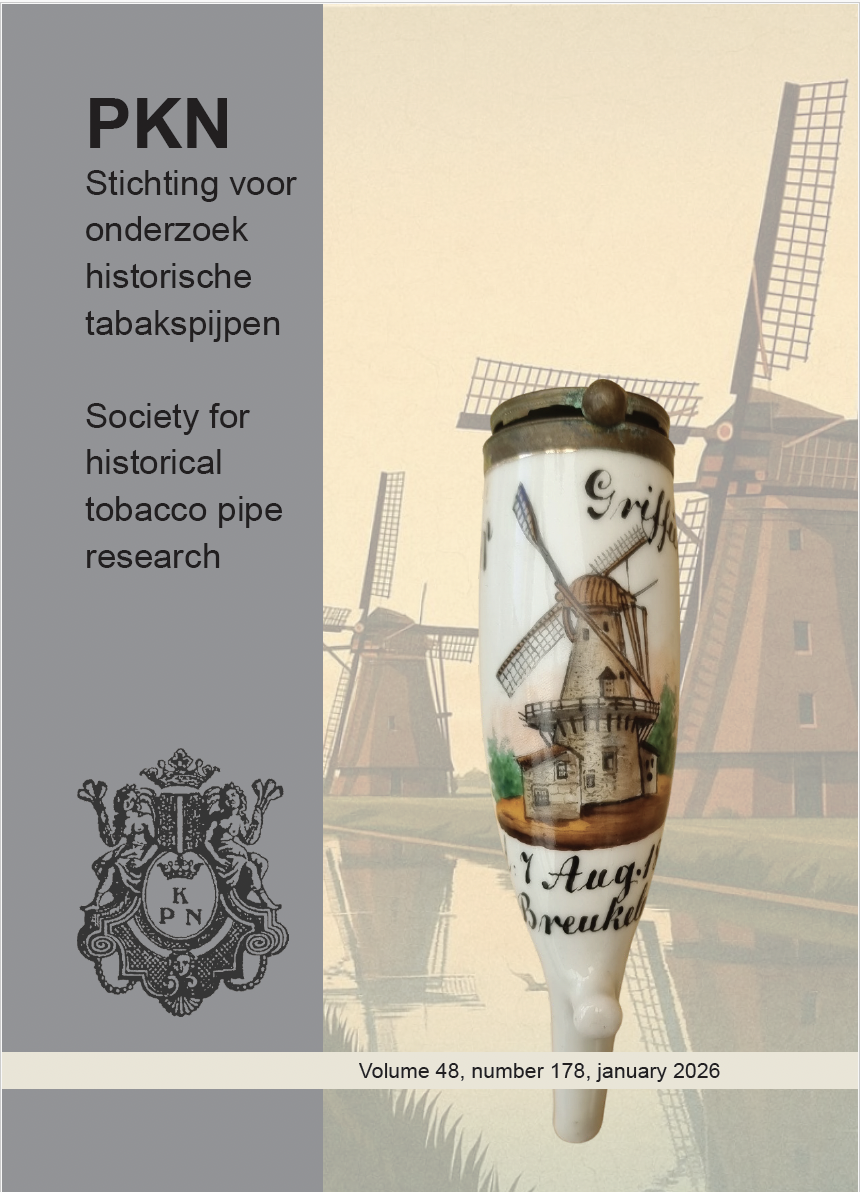
The pipe of miller Jacob Griffioen (1836–1912)

- From the mid-eighteenth century onwards, porcelain tobacco pipes were produced in Germany. Initially, these were mainly luxury products intended for the wealthy upper classes. These pipes were often regarded as small works of art, richly decorated with refined paintings and elegant details. The article describes a custom-made pipe for a water miller named Jacob Griffioen. On the front of the bowl, a hand-painted inscription in black has been applied: “Jakop Griffieoen geb: d: 7 Aug. 1837 te Breukelen.” Between the text, a mill is depicted in shades of grey and brown, with several trees in the background.
A pipe made with an unusual technique - Ruud Stam

- An article about a pipe whose bowl is decorated not by an engraving applied in the mould, but by an engraving made by hand when the pipe had not yet dried.
A remarkable pipe with the inscription “Gut Schlauch” and a pipe with “Glück Auf” from the Westerwald - Ruud Stam


- In the depot of the Keramikmuseum Westerwald there is a remarkable pipe that was made for fire brigades. It is a completely green-glazed pipe. Fully glazing a pipe is very unusual in the Westerwald. On the pipe there is an emblem with hammers and axes, a ladder and ropes, with a fire helmet above the emblem and the motto GUT SCHLAUCH. Another pipe discussed here bears the wish GLÜCK AUF, and although the pipe also features various miners’ symbols, it was not made as a general pipe for miners, but as a pipe produced in the context of the social struggle of the miners.
A gift box from Johann Spang Söhne in Ransbach

- A fine example of a gift set for a pipe smoker is a small box that was marketed by the firm Johan Spang from Baumbach. It contains three simple, sturdy pipes, a bundle of 10 pipe cleaners, and a “D.R.G.M. Tabakfeuchter,” that is, a small stone that could be moistened and placed in a tobacco jar to keep the tobacco damp. On the lid there is also a short poem promoting the gift.
Fiolet Pipes for the French army - Ewout Korpershoek

- On 19 January 1855 and in the days that followed, the following report appeared in various French newspapers concerning a donation of 20,000 pipes by the firm Fiolet to the l’armée d’Orient. This was, in that period, the designation for the French army units active during the Crimean War (1853–1856). This donation followed an earlier, unspecified contribution by the firm Duméril and a donation of 100,000 pipes by the municipality of Saint-Omer (fig. 1). In addition to the donation of 20,000 pipes, the firm Fiolet also presented a box of pipes bearing the likeness of General Canrobert, made after a sculpture by the artist Braquet. The article pays attention to three pipes featuring Canrobert’s image, including an example by the French firm Billiet.